
It is exciting having a Shopify store, but it can get quite overwhelming in no time. You have a lot on your plate, right from managing products to taking care of orders, writing descriptions, and even marketing your store. Navigating the world of Shopify web development shouldn’t mean adding massive overhead to your budget. The good news? You don’t have to do it all manually, and you definitely don’t have to spend a fortune on tools.
The Shopify App Store has over 10,000 apps, and a surprising number of them offer genuinely useful free plans. Not watered-down trials — actual free plans that can be useful for your business. Whether you’re just launching your first store or already have orders coming in, the right free apps can save you hours every week and help you grow faster.
This blog covers the 10 best free Shopify apps across every major area — SEO, customer support, email marketing, reviews, page design, and more. Each pick is based on real store owner ratings, feature value, and how well they actually perform on a free plan.
Quick Comparison Table
| App | Category | Free Plan | Best For | Rating |
| Judge.me | Reviews | Forever free | Building social proof | 5.0 ⭐ |
| TinyIMG | SEO & Speed | 50 images/month | Faster load times | 4.9 ⭐ |
| Tidio | Live Chat | Up to 50 conversations | Customer support | 4.7 ⭐ |
| Klaviyo | Email Marketing | 250 contacts, 500 emails | Email list building | 4.6 ⭐ |
| PageFly | Page Builder | 1 published page | Landing page design | 4.9 ⭐ |
| DSers | Dropshipping | Up to 3 stores | AliExpress dropshipping | 5.0 ⭐ |
| Shopify Inbox | Customer Chat | Completely free | Real-time buyer conversations | 4.6 ⭐ |
| UpPromote | Affiliate Marketing | Unlimited affiliates | Referral-driven growth | 4.9 ⭐ |
| Smile.io | Loyalty & Rewards | Points + referrals | Repeat customers | 4.8 ⭐ |
| ReConvert | Post-Purchase Upsell | Free plan available | Increasing order value | 4.9 ⭐ |
What Makes a Shopify App Worth Installing?
There are thousands of apps available, and it’s very easy to go overboard and install things that you won’t actually use. Before adding anything to your store, ask three simple questions:
Will it directly solve a problem my store has right now?
Does the free plan offer enough value to be useful — or is it just a teaser for a paid upgrade?
And do real store owners rate it well — not just on paper but in actual day-to-day use?
Every app on this list clears all three. Now let’s get into them.
10 Best Free Shopify Apps to Grow Your Store
1. Judge.me — Best for Product Reviews
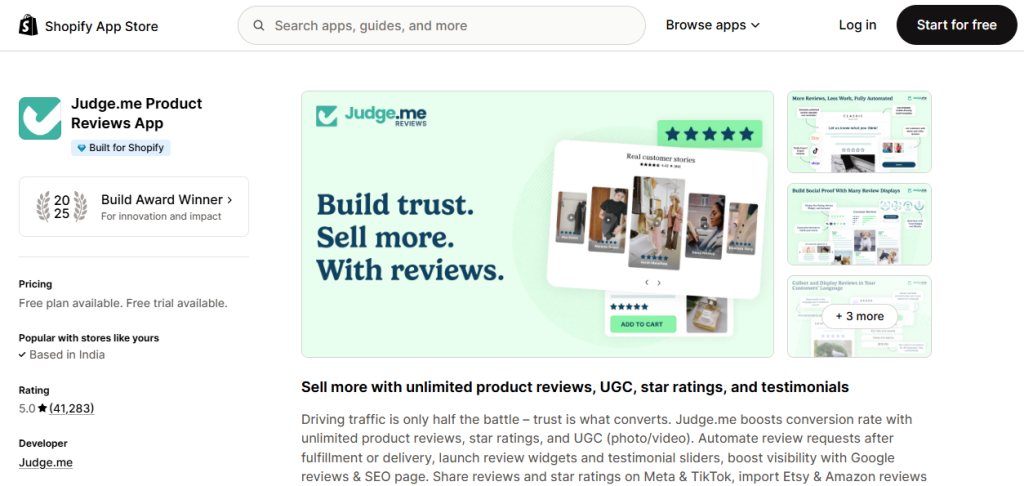
If there’s one thing that converts a hesitant browser into a buyer, it’s honest product reviews. Judge.me is one of the best review apps on the Shopify App Store — and its free plan is genuinely complete.
With the forever-free plan, you get unlimited review requests, unlimited reviews displayed on your store, photo and video reviews, automatic review request emails after purchase, and widgets that show star ratings on product pages. It also supports 37 languages, which is a big deal if you’re selling internationally.
What makes Judge.me stand out is that it doesn’t lock the most important features behind a paywall. You get real social proof working for your store from day one. Store owners consistently rate it 5.0 stars with over 30,000 reviews on the App Store — making it one of the most trusted apps in the entire Shopify ecosystem.
Best for: New stores that need to build credibility quickly and any store where reviews are the main purchase trigger.
2. TinyIMG — Best for SEO and Page Speed
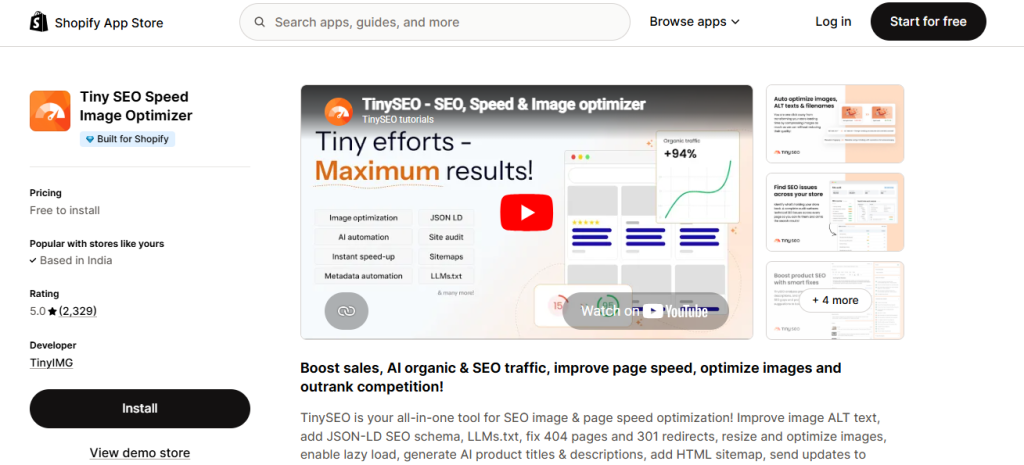
Slow stores lose customers. It’s that simple. If your product images are heavy and unoptimised, your page speed suffers — and so does your Google ranking. TinyIMG fixes this without you having to touch a single line of code.
The free plan gives you 50 image optimisations per month along with automatic ALT text generation, broken link detection, 404 redirect fixes, and an SEO report that flags what’s hurting your rankings. It also handles lazy loading, which means images only load when a visitor scrolls to them — keeping your store fast on both desktop and mobile.
One feature that is actually great in 2026 is TinyIMG adding AI-generated meta descriptions and product titles. This saves stores with large product catalogues hours of manual SEO work.
Ideal for: Stores with many product images or any store looking to boost their Google ranking without hiring an SEO technician.
3. Tidio — Best for Live Chat and Customer Support
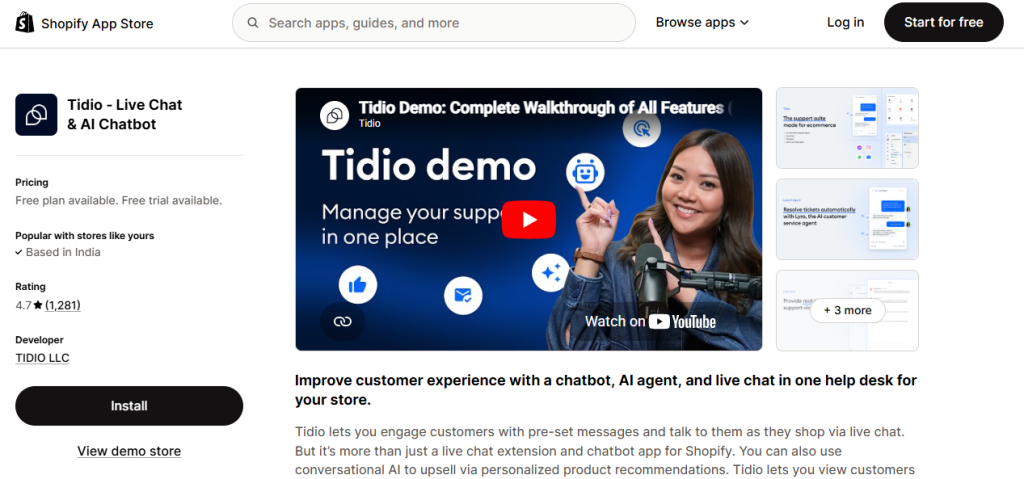
Customers have questions before they buy. If they can’t get a quick answer, they leave — and they don’t come back. Tidio solves this by putting a live chat widget on your store that actually works.
The free plan includes live chat, a basic AI chatbot that can handle common questions automatically, and a unified inbox where you can manage conversations from your store, email, and Messenger in one place. Setup takes under 10 minutes, and the chat widget is fully customisable to match your store’s branding.
What separates Tidio from other chat apps is how well the free chatbot works. It is not only able to voice answers to FAQs or recommend products, but it can also answer some cart queries — which means you’re not glued to the phone waiting to manually respond.
Who will relate most to: Stores that receive lots of questions before purchase, dropshippers, and any store selling expensive products.
4. Klaviyo — The Best Email Marketing Solution
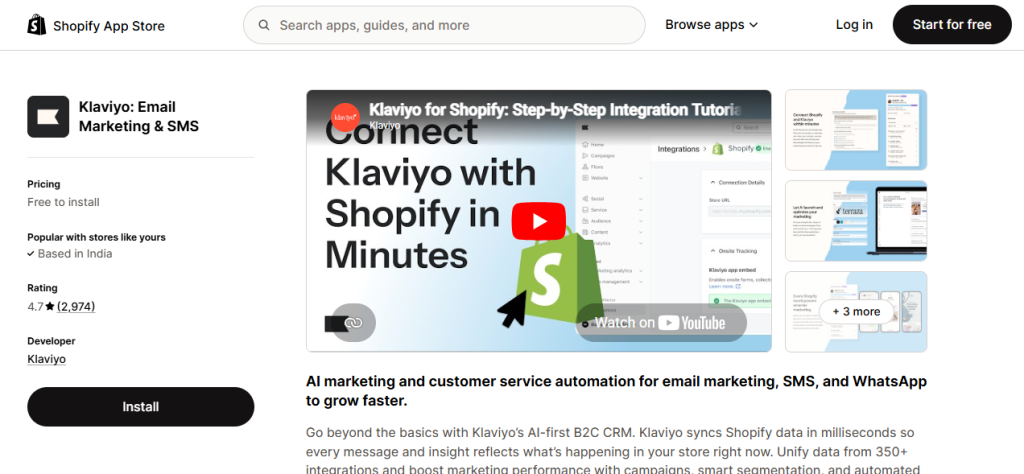
Email marketing is one of the digital marketing channels with the highest ROIs — and Klaviyo is the preferred email app used by Shopify stores around the world. The free plan gives you access to 250 contacts and 500 email sends per month — more than enough to test your initial strategies and see what works.
With the free plan come pre-built email flows, such as welcome sequences, abandoned cart recovery emails, and post-purchase follow-ups. You also get access to Klaviyo’s drag-and-drop email builder and basic segmentation — so you can send the right email to the right customer at the right time.
Klaviyo syncs directly with your Shopify store, which means customer purchase data flows in automatically. You don’t need to import anything manually. For a store just starting to build its email list, this is one of the smartest free tools you can add.
Best for: Stores at any stage that want to build an email list, recover abandoned carts, and drive repeat purchases through automated email flows.
5. PageFly — Best for Landing Page Design
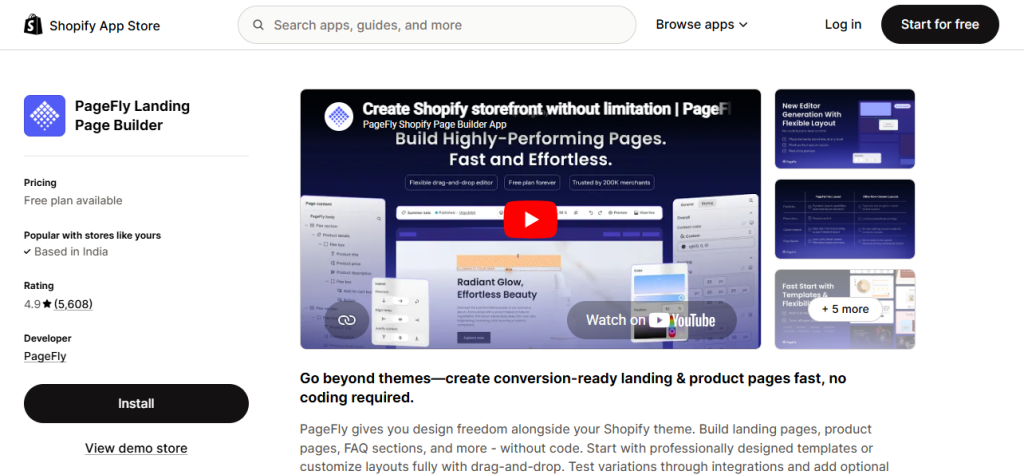
Shopify’s default themes are decent — but they’re limited. If you want to build a high-converting product page, a promotional landing page, or a custom homepage section without writing code, PageFly is what you need.
The free plan gives you one published page with access to the full drag-and-drop editor. You can add countdown timers, product variants, sales banners, trust badges, and custom layouts — everything you’d normally pay a developer for. PageFly also offers a Gen 2 editor for more advanced, flexible layouts if you’re comfortable going beyond the basics.
The biggest advantage of PageFly is how much it improves the conversion rate. A well-designed landing page built in PageFly consistently outperforms a default Shopify product page because you have full control over what a visitor sees and where they click.
Best for: Stores launching new products, running ad campaigns that need dedicated landing pages, or anyone who wants more design control without touching code.
6. DSers — Best for Dropshipping
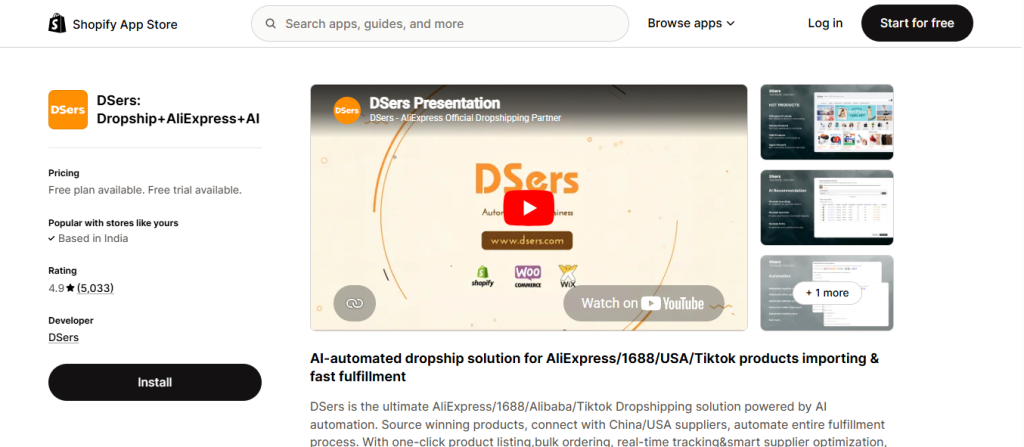
If you’re running a dropshipping business on Shopify, DSers is the official AliExpress-recommended partner app — and the free plan is more capable than most people realise.
With DSers free, you can manage up to 3 Shopify stores, import products directly from AliExpress, place bulk orders with a single click, and track shipments automatically. It also has a supplier optimiser feature that helps you find better suppliers for products you’re already selling — which is a genuinely useful tool for improving margins and delivery times.
DSers replaced Oberlo as the go-to dropshipping app after Shopify shut Oberlo down, and it’s only gotten better since. The interface is clean, the AliExpress integration is seamless, and the bulk order processing alone saves hours every week for active dropshippers.
Great for: Dropshipping store owners who find products on AliExpress and want to automate order fulfilment.
7. Shopify Inbox — Best for Having Conversations With Buyers
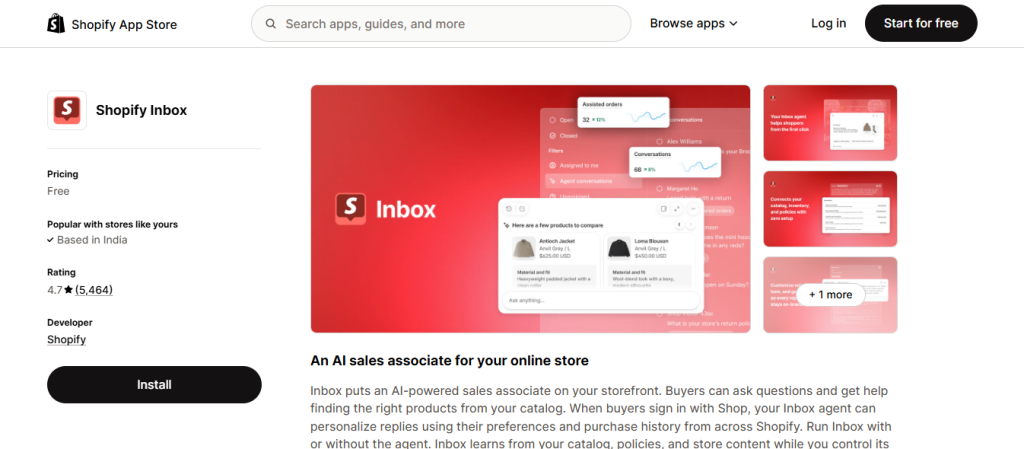
Shopify Inbox is a free native app built by Shopify itself, offering zero setup friction and seamless integration with your store. It allows you to communicate with customers in real time within your store and manage these conversations from a PC or smartphone.
What makes Shopify Inbox particularly smart is that it shows you what’s in a customer’s cart while you’re chatting with them. So when someone asks “Does this come large?”, you can already see what they have been viewing and respond in full context — this greatly improves the quality of support you are able to provide.
You can also set up quick replies for your frequently asked questions (so you aren’t writing the same answers over and over). As it’s a native app built specifically for Shopify, there’s no compatibility issue, and it never slows down your store.
Best for: Every Shopify store, regardless of size. This is a no-brainer install.
8. UpPromote — Best for Affiliate Marketing
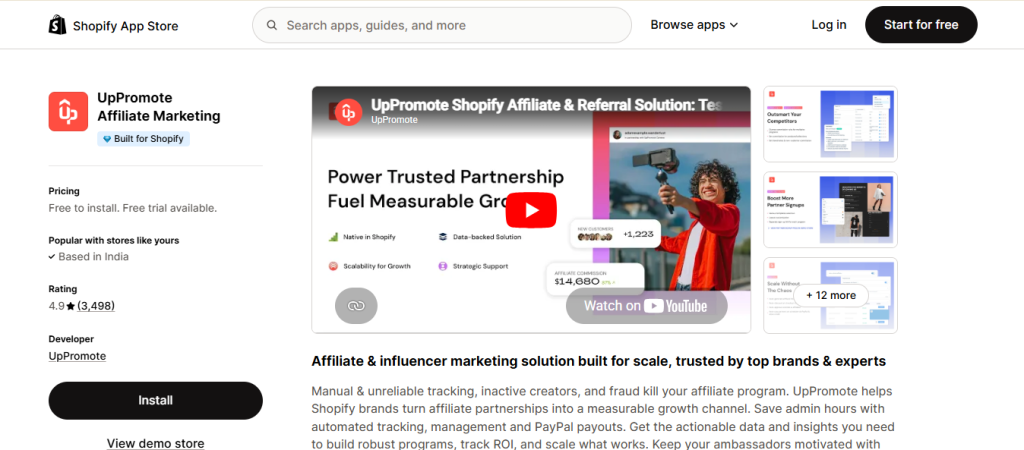
Word-of-mouth is still one of the most powerful ways to grow a store — and UpPromote makes it easy to turn that into a structured affiliate programme without any upfront cost.
The free plan gives you unlimited affiliates, 200 referral order approvals per month, referral link and coupon tracking, an affiliate dashboard where your promoters can track their own performance, and access to the UpPromote marketplace where you can list your programme and get discovered by new affiliates.
Setting up an affiliate programme used to require expensive software or a developer. UpPromote makes it a 30-minute job. For stores that want to grow without spending heavily on paid ads, this is one of the most cost-effective growth channels available.
Best for: Stores with products that have a natural community around them — fitness, lifestyle, fashion, beauty, and education niches tend to get the most out of affiliate programmes.
9. Smile.io — Best for Loyalty and Rewards
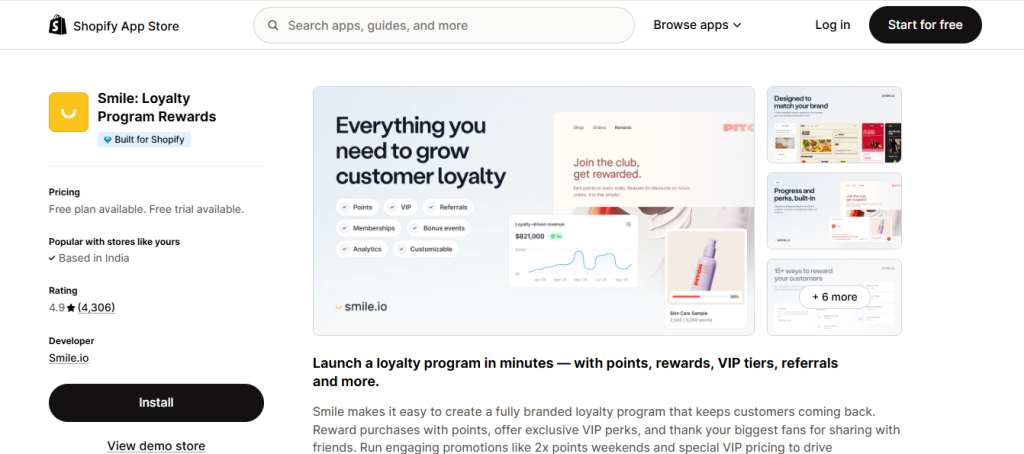
Getting a new customer costs far more than keeping an existing one. Smile.io helps you keep customers coming back by giving them a reason to — through a points and rewards programme that runs automatically in the background.
The free plan includes a points programme where customers earn points for purchases, a referral programme where existing customers can bring in new ones, and a basic rewards launcher that sits on your storefront. Customers can see their points balance and redeem rewards directly — which creates a habit of coming back to your store over a competitor.
Smile.io has over 100,000 Shopify stores using it, and the impact on repeat purchase rate is well-documented. You can have a loyalty program with the free plan that seems premium while slowly establishing a genuine affinity for your brand.
Ideal for: Stores looking to create a loyalty program — subscription boxes, consumables, as well as fashion and beauty stores have built the best experiments with it.
10. ReConvert — Ideal for Post-Purchase Upsells
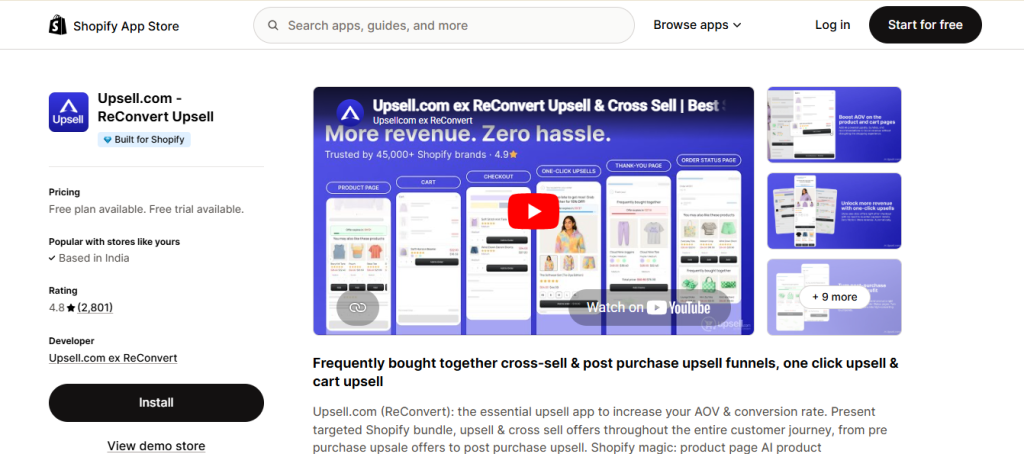
Most stores focus all their energy on getting customers to check out. ReConvert focuses on what happens right after — and that’s where a lot of money is being left on the table.
ReConvert lets you customise your order confirmation page with upsell offers, cross-sell product recommendations, birthday collectors, and reorder buttons. The free plan is available for newer, lower-volume stores. Since the customer has just bought from you and trust is at its highest, this is the best moment to offer them something additional — and ReConvert makes that process smooth and non-pushy.
Average order value is one of the fastest levers to pull when growing a Shopify store, and post-purchase upsells are one of the cleanest ways to do it without disrupting the checkout experience.
Best for: Any store that wants to increase revenue per customer without spending more on traffic.
Free vs Freemium — Know the Difference
A quick note before you start installing: not all “free” apps are the same. Some apps like Judge.me and Shopify Inbox are genuinely free with no meaningful limitations. Others like Klaviyo and PageFly offer free plans that are useful but have caps — contact limits, page limits, or conversation limits — that you’ll eventually hit as you grow.
Neither is a problem. Just go in knowing what you’re getting. Start with the free plan, get value from it, and upgrade only when you’ve genuinely outgrown it — not before.
How to Choose the Right Free Apps for Your Store
Start with your biggest bottleneck, not the most popular app. If customers are bouncing because your pages are slow, install TinyIMG first. If you’re losing sales because people have unanswered questions, start with Tidio or Shopify Inbox.
Don’t install everything at once. Too many apps can slow your store down and create a cluttered backend. Add one or two at a time, let them run for a few weeks, and measure the impact before adding more.
And always check the reviews — specifically the negative ones. They’ll tell you exactly what the free plan doesn’t do, which saves you a nasty surprise later.
Final Thoughts
Growing a Shopify store doesn’t have to mean growing your expenses at the same pace. The apps on this list cover every major area of your store’s performance — and all of them are genuinely usable without spending a rupee.
Start small, be intentional, and let the tools do the heavy lifting while you focus on the bigger picture.
Looking to build a high-performance Shopify store from scratch? Softhunters creates custom-tuned e-commerce solutions ready to convert. Whether you need front-end design or back-end development, we build stores that do more than just look good.
FAQs
Are free Shopify apps really free?
Not all of them. Some Shopify apps, such as Shopify Inbox and Judge.me, offer genuinely free plans with core features available at no cost. Others, including Klaviyo, PageFly, TinyIMG, and ReConvert, follow a freemium model, where the free plan includes useful functionality but comes with limits such as contact caps, page limits, or monthly usage restrictions. The apps in this list all provide a free plan that offers real value, allowing you to use them effectively before deciding whether you need a paid upgrade.
How many apps can I install on Shopify for no cost?
Shopify does not limit how many apps you can install— free or paid. Although you may want to use
Do free Shopify apps hurt my store’s speed?
Sure, some can (especially page builder and popSome can, yes — especially page builder and live chat apps, which tend to load extra scripts and assets. Before installing anything, check its impact on your store’s speed using Shopify’s built-in speed report. Native tools like Shopify Inbox tend to be the lightest, since they’re built directly into the platform. Apps like PageFly and Tidio may add more to load time depending on how many features you use, so it’s worth testing before and after installation to see the real impact on your store.up apps). Before you install anything, always check its impact on performance. Apps like Shopify Inbox and Judge.me are lightweight. PageFly and Tidio add slightly more to load time, but the trade-off is worth it.
Which free Shopify app is great for a brand-new store?
Start with Shopify Inbox, Judge.me, and TinyIMG. Between them, you’re covering customer communication, social proof, and page speed — the three areas that determine whether a new visitor trusts your store enough to buy.