Digital marketing is the full set of online ways to promote a business. Performance marketing is the part of it that is paid for and measured by clear actions such as leads or sales. So it does not replace digital marketing. It works inside it.
If you are picking a digital marketing agency in Jaipur, this difference matters. It tells you what to ask for, what to track and how to judge the results. This guide explains both in simple words.
What Is Digital Marketing?
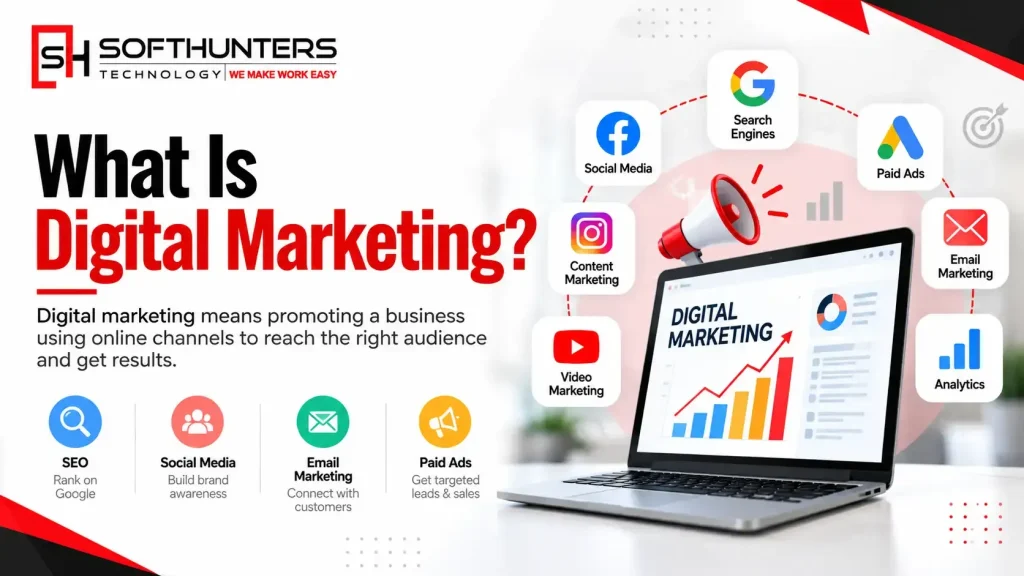
Digital marketing means promoting a business through digital media. That includes websites, search engines, social media, email and mobile apps. Common channels are SEO, search ads, social media, email, content, display ads and affiliate marketing.
You can divide these channels into two groups:
- Organic: SEO, content, social posts and email lists. You do not pay for each view or click.
- Paid: Search ads, social ads and display ads. You pay the platform to show your message.
- Performance-based: Affiliate marketing. You pay a partner only when a sale or lead happens.
The goal can be anything. Some businesses want more people to know their name. Others want visits, enquiries or sales.
What Is Performance Marketing?
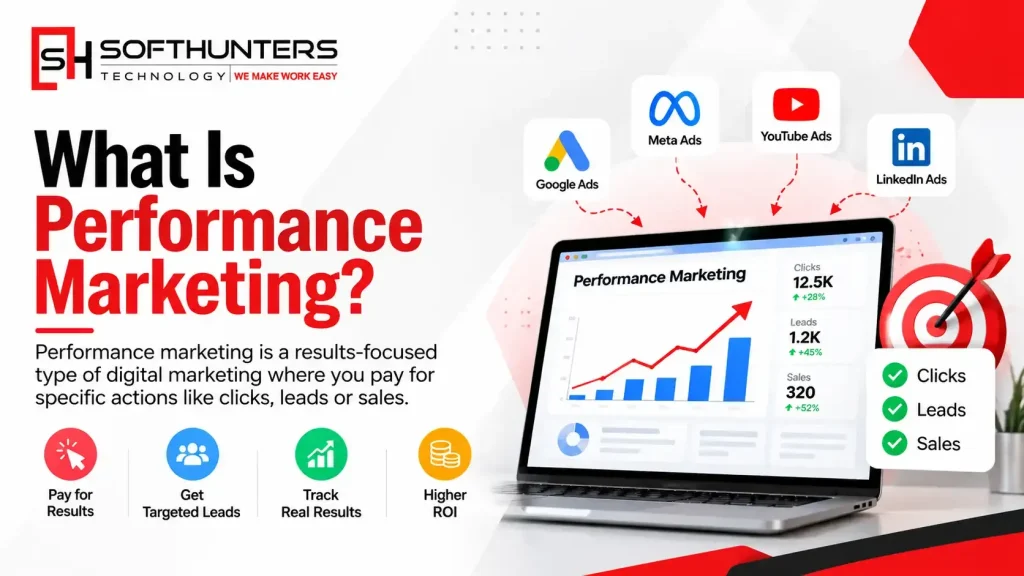
Performance marketing is a results-focused approach, most often used in paid campaigns, where success is tied to a clear action. That action can be a click, a lead, a sign-up or a sale. You set the target first and then check if the campaign meets it.
Four pricing models are common: CPM, CPC, CPL and CPA. We explain them below.
Performance marketing is not a separate world. It sits inside digital marketing. A search ad that brings an enquiry is performance marketing. A blog post that builds trust over months is organic digital marketing. It is not usually paid per result.
Performance Marketing vs Digital Marketing: Key Differences
| Aspect | Digital marketing | Performance marketing |
| Main goal | Awareness, traffic, trust and sales | A set action, such as a lead or a sale |
| Scope | Wide, from SEO to email | A results-focused part of paid marketing |
| How you judge it | Reach, traffic, engagement, conversions | Cost per lead, cost per sale, ROAS |
| Cost | A mix of fees, ad spend and tools | Often linked to clicks, leads or sales |
| Tracking | Helpful | Essential, because results guide spending |
| Example | A blog post that ranks on Google | A lead-form ad with a target cost per lead |
Both have limits. Performance campaigns are only as good as your tracking. They can also chase cheap leads that never buy. Broader digital work, like SEO and content, often builds over months and can be harder to link to a single sale.
Pricing Models and Metrics That Matter
Here are the four pricing models in plain words:
- CPM: Cost per mille. You pay for every 1,000 times your ad is shown.
- CPC: Cost per click. You pay each time someone clicks.
- CPL: Cost per lead. You pay for each enquiry or form fill.
- CPA: Cost per acquisition or action. You pay for a set action, such as a sale.
CPM is the exception. You pay for views, not actions. So performance marketing does not always mean you pay only when a sale happens. If you use CPM, track clicks, leads and sales separately to know whether the campaign works.
Next, the numbers that tell you if it works:
- ROAS: Revenue from ads divided by ad spend.
- CAC: The cost of winning one new customer.
- LTV: What a customer is expected to spend with you over time.
Here is a simple example. You spend ₹20,000 on ads. They bring 10 sales worth ₹60,000. Your ROAS is 3. Your cost per sale is ₹2,000. Now say each sale leaves ₹1,500 in profit before ad costs. That is ₹15,000 in total. After the ₹20,000 ad spend, you are ₹5,000 down. A good ROAS alone does not prove a campaign is profitable. If a customer is worth ₹10,000 over time, paying ₹2,000 to win them is healthy.
The same goes for clicks. A low CPC looks nice. But if those clicks never buy, they are not cheap.
Two more ideas help here:
- Lead quality: 100 leads are not better than 20 if only two become customers. Track which leads turn into sales.
- Attribution: This decides which ad or channel gets credit for a sale. A person may see a social ad, search later and buy after a search click. Without tracking, you may credit the wrong channel.
How Brand and Performance Work Together
Think of a buying journey with three stages: awareness, interest and action.
- Content, SEO and social posts help people find and trust you.
- Performance campaigns push people toward a clear action.
They support each other. A buyer who already knows your name is often easier to win with a search ad. A good ad sends people to a site that also needs to be clear and easy to use.
The money is moving this way too. The dentsu–e4m India Digital Advertising Report 2026 puts digital ad spend in India at ₹71,621 crore in 2025, up 19%. That is about 59% of the ₹1,21,339 crore total ad industry. Dentsu expects digital to reach ₹98,034 crore and nearly 70% of ad spend by 2027. This shows how big digital advertising has become, not which approach is better.
Which One Should You Choose?
Neither is better on its own. They do different jobs. Start with your goal.
- You are new and few people know you: Build awareness first with content, social and SEO.
- You need enquiries or sales: Run performance campaigns, such as search ads or lead ads, with tracking set up first.
- You want steady growth: Use both. Let brand work build trust and performance work close the sale.
Examples for Jaipur Businesses
These examples show how the two work together. They are simple illustrations, not case studies.
- A jewellery store: Use social posts and ads to show new designs. Use search ads for people already looking to buy. Measure enquiries, store visits where you can track them, and purchases.
- An education institute: Run ads to bring admission enquiries. Measure qualified leads, counselling bookings and enrolments, not only form fills.
- A real estate business: Run campaigns for property enquiries. Track qualified prospects, site visits and bookings.
A digital marketing agency in Jaipur can set this up. The key is to measure the step that matters to your business, not just the click.
Common Mistakes to Avoid
- Running ads before tracking is set up.
- Judging a campaign by clicks or likes alone.
- Counting every lead the same, even when most never buy.
- Judging results too early, with too little data.
On that last point, Google’s Smart Bidding uses Google AI to set bids for conversions or conversion value, and it needs conversion tracking to work. To judge results fairly, Google recommends looking at a month or longer, with at least 30 conversions (50 for Target ROAS). This is a guide, not a rule for every campaign, because the numbers vary by campaign type.
How to Choose a Digital Marketing Company in Jaipur
A good partner is clear about what it will do and how it will report. Ask these questions:
- Will the ad accounts and tracking be in my name?
- How do you measure leads, and do you track lead quality?
- Do you show ad spend and your fee separately?
- How often will you report, and which numbers?
- How will you count qualified leads?
- What are the contract terms if I want to stop?
Can you share a sample report?
Conclusion
Performance marketing vs. digital marketing is not a choice between rivals. Performance marketing is one results-focused part of digital marketing. Use brand work to build trust and performance work to get actions. Track what matters, and judge results by profit, not clicks.
When you choose a digital marketing service in Jaipur, ask how it tracks results and reports them.
About Softhunters India
Softhunters India is a Jaipur-based digital marketing company with 17+ years of experience and 9,000+ projects handled. Its services include performance marketing, search engine marketing, SEO, social media marketing, email marketing, lead generation and content writing.
Want to plan your next campaign? Talk to the Softhunters team through the contact page.
FAQs
Q1. Is performance marketing part of digital marketing?
Ans: Yes. Digital marketing is a broad field. Performance marketing is a results-focused way of running paid campaigns within it.
Q2. What is performance marketing in simple words?
Ans: It is paid marketing built around a clear action, like a lead or a sale. You set a target, track the results and adjust your spending.
Q3. Which is better, performance marketing or digital marketing?
Ans: It depends on your goal. Digital marketing builds awareness and trust, while performance marketing aims at set actions like leads or sales. Most businesses use both.
Q4. Does performance marketing mean paying only when a sale happens?
Ans: Not always. Some models charge per click, lead, or action. CPM charges for views, even without a click.
Q5. Can a small business use both performance marketing and digital marketing?
Ans: Yes. Start with one clear goal and set up tracking. Then add more channels as you learn what works.