
To build an app like Uber, you need three connected products: a rider app, a driver app and an admin panel. Add live GPS tracking, fare estimates, online payments, and basic safety tools, then launch in one city. For a basic cross-platform version built by an Indian team, plan on 4 to 6 months and about $25,000 to $50,000 (₹24 lakh to ₹47 lakh). If you do not have an in-house team, a taxi booking app development company can build all three parts for you.
This guide covers which features to build first, which technology to pick, how the cost adds up, and which Indian rules to check before you launch. If you plan to hire a partner, look for taxi app development services that include design, testing and launch support.
How Does an App Like Uber Work?
A ride-hailing app looks simple on the phone. Behind the screen, three parts work together.
- The rider enters a pickup and drop-off location and sees a fare estimate.
- The app finds nearby drivers and sends the request to the best match, based on distance and availability.
- The driver accepts, reaches the pickup point and starts the trip.
- The rider tracks the trip live and pays in the app.
- Both sides rate each other.
Meanwhile, someone on the admin side monitors active trips, handles cancellations, and fixes problems. In a small taxi business, this is often a human dispatcher. In a big one, software does most of the work.
Every taxi booking app, whether it serves one city or fifty, follows this same loop. What changes is how smart and how safe each step is.
Must-Have Features of an Uber-Like App
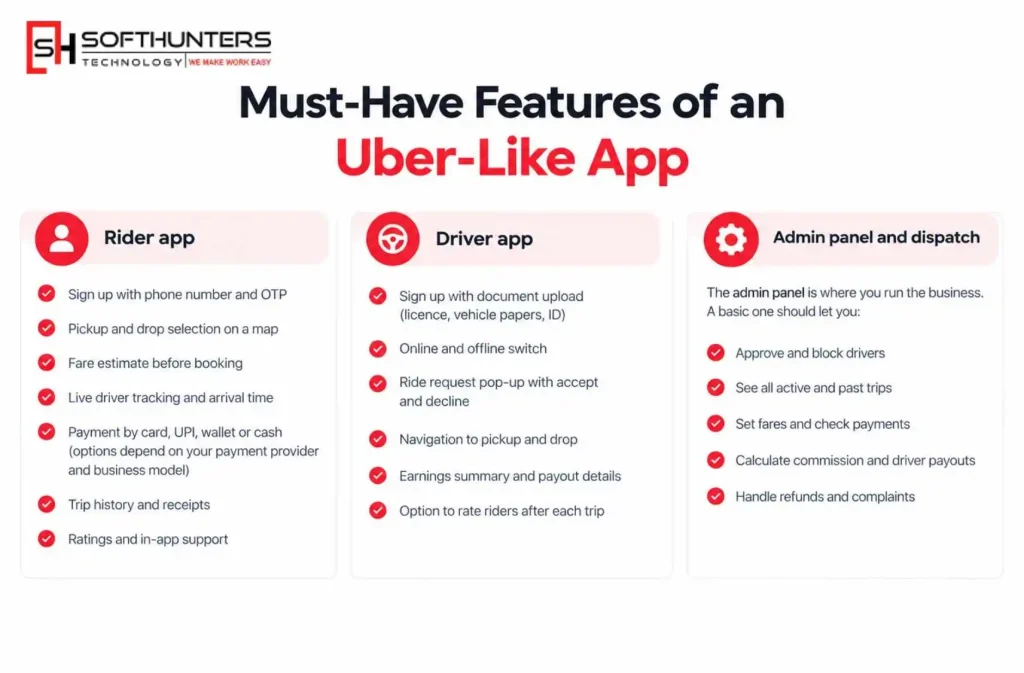
Most founders want everything on day one. That is the quickest way to burn money. Build the features below first. They give you a working and safe product.
Rider app
- Sign up with phone number and OTP
- Pickup and drop selection on a map
- Fare estimate before booking
- Live driver tracking and arrival time
- Payment by card, UPI, wallet or cash (options depend on your payment provider and business model)
- Trip history and receipts
- Ratings and in-app support
Driver app
- Sign up with document upload (licence, vehicle papers, ID)
- Online and offline switch
- Ride request pop-up with accept and decline
- Navigation to pickup and drop
- Earnings summary and payout details
- Option to rate riders after each trip
Admin panel and dispatch
The admin panel is where you run the business. A basic one should let you:
- Approve and block drivers
- See all active and past trips
- Set fares and check payments
- Calculate commission and driver payouts
- Handle refunds and complaints
Dispatch tools matter more than most guides admit. If you run a fleet or take bookings by phone, you will need manual ride assignment, a live view of driver availability and a way to cancel or reassign a trip. A small MVP can start with manual assignment and a simple list of active trips. A larger fleet needs a live map, driver filters and booking logs.
Safety belongs in the MVP
Do not push safety to version two. At launch, include:
- Driver identity and document checks before approval
- An SOS or emergency contact button
- Trip sharing with family or friends
- A way to report a problem and reach support
These are product choices, not only legal ones. A rider who feels unsafe will not open your app twice.
Advanced Features for Version 2
Once you have real rides and real feedback, add features that improve speed and income.
- Smart dispatch and arrival time prediction. Software that picks the driver who can reach the rider fastest, using traffic and past trip data.
- Dynamic pricing. Fares that rise when demand is high. Indian rules limit how far fares can move (more on this below).
- Fraud checks. Alerts for fake trips, odd routes or repeat cancellations.
- More ride types. Bikes, autos, SUVs, women-only rides or wheelchair-friendly cars.
- Extra languages and scheduled rides.
- Analytics. Reports on peak hours, driver earnings and cancellations.
Add these one at a time. Each one needs testing, and each one adds cost.
Technology Stack to Build an App Like Uber
You do not need a rare or costly stack. Proven tools work well. The right choice depends on your budget and how fast you want to grow.
| Layer | Common options | When to pick it |
| Mobile apps | Flutter or React Native | One codebase for Android and iOS. Good for MVPs and tight budgets. |
| Mobile apps | Kotlin (Android) and Swift (iOS) | Better speed and device access. Good for mid-level and large products. |
| Backend | Node.js, Python or Java | Node.js is popular for real-time apps. Java suits big, complex systems. |
| Database | PostgreSQL or MySQL, plus Redis | Postgres for trip and transaction records. Redis for fast live location data. |
| Real-time | WebSockets or Socket.IO | Live driver location and trip status. |
| Maps | Google Maps Platform or Mapbox | Routes, arrival time, addresses. Check pricing, because map calls add up. |
| Payments | Razorpay, Stripe, PayU or Cashfree | Pick one that supports UPI and driver payouts. Let the provider store card details, not your database. |
| Notifications | Firebase Cloud Messaging or an SMS provider | Booking alerts and OTPs. |
| Cloud | AWS, Google Cloud or Azure | Start small. Scale when rides grow. |
One practical tip: start with a single, well-built backend instead of splitting it into many small services. It is easier to fix and cheaper to run. You can break it up later when traffic demands it.
Step-by-Step Uber Clone App Development Process
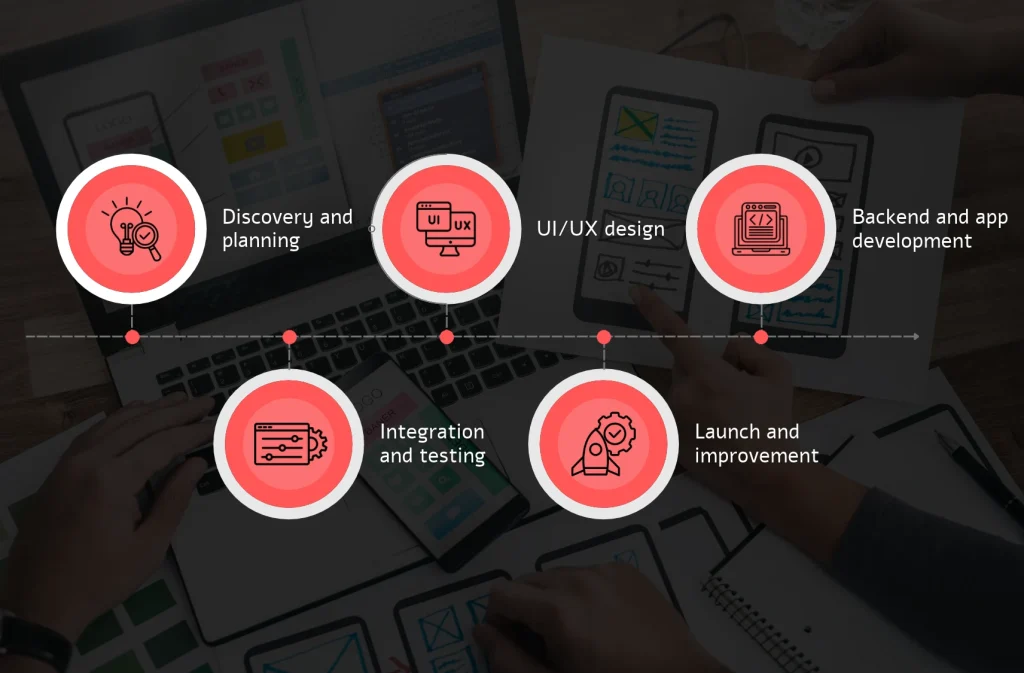
Here is how to build an app like Uber in phases. Some phases overlap, so the timings below are rough durations for an MVP.
- Discovery and planning (2 to 3 weeks). Decide your city, your riders and drivers, your feature list and your budget. Also decide what stays out of version one.
- UI/UX design (3 to 4 weeks). Wireframes first, then screens. Drivers use the app while driving, so keep their screens very simple.
- Backend and app development (10 to 14 weeks). The rider app, driver app, admin panel and APIs are built side by side.
- Integration and testing (3 to 4 weeks). Maps, payments and notifications get connected. A few drivers test it on real roads, with weak GPS and network too. Test driver sign-up, duplicate requests, cancellations and payment settlement as well.
- Launch and improvement (1 to 2 weeks to submit, then ongoing). App store approval, a pilot in one area, then fixes based on feedback.
Add these up and you get 19 to 27 weeks. But design starts while discovery ends, and testing starts before development finishes. So a realistic MVP timeline is about 4 to 6 months. That assumes a clear scope, quick approvals and one launch city. Mid-build changes push the date.
Your partner matters as much as the technology. If you plan to hire a taxi booking app development company, ask for live apps they built, not only screenshots. Ask who will own the source code. Ask what happens after launch. Good taxi app development services should cover design, development, testing, app store launch and support, with clear milestones.
Uber-Like App Development Cost
How much will it cost? It depends on what you build. Published guides range from under $20,000 to over $300,000, because they describe very different products. So we estimate by scope. We looked at the hours each scope needs and at typical Indian agency rates. The prices below are approximate ranges, so please read them as a starting point.
For planning, budget about $25,000 to $50,000 for a custom, cross-platform MVP built by an India-based team. That assumes a rider app, a driver app, a basic admin and dispatch panel, driver payouts and standard integrations. Fleet tools, advanced dispatch, heavy compliance work or scope changes push the number up. Treat it as a planning estimate for a defined scope, not an industry standard.
Typical Indian agency rates are roughly $20 to $50 an hour, about ₹1,900 to ₹4,700. Rates vary by team size and experience.
| MVP | Mid-level | Full-featured | |
| Cost (USD) | $25,000 to $50,000 | $50,000 to $100,000 | $100,000 to $200,000+ |
| Cost (INR) | ₹24 lakh to ₹47 lakh | ₹47 lakh to ₹95 lakh | ₹95 lakh to ₹1.9 crore+ |
| Platforms | Android and iOS (cross-platform), web admin | Android and iOS, web admin with dispatch panel | Native apps, web admin, multi-city operations |
| Timeline | 4 to 6 months | 6 to 9 months | 9 to 12+ months |
| Main inclusions | Rider and driver apps, basic admin, maps, payments, driver payouts and reconciliation, SOS, trip sharing, driver checks | Promo codes, scheduled rides, driver payouts, reports, richer dispatch tools, more payment options | Smart dispatch, dynamic pricing, deep analytics, many ride types, multiple cities, integrations |
| Usually excluded | AI features, multiple cities, advanced reports | Advanced AI features, large fleet tools | Marketing and launch spending |
These are approximate build costs. They do not include hosting, map and SMS charges, taxes, yearly maintenance or compliance costs. Compliance (security audit, insurance, licensing, driver training): budget separately.
Where the MVP budget goes
This split is our estimated allocation of the MVP budget. It is not a set of separate vendor quotes.
| Part | USD | INR |
| Discovery and UI/UX design | $3,000 to $6,000 | ₹2.8 to ₹5.7 lakh |
| Backend and APIs | $6,000 to $12,000 | ₹5.7 to ₹11.4 lakh |
| Rider and driver apps | $9,000 to $18,000 | ₹8.5 to ₹17.1 lakh |
| Admin and dispatch panel | $3,000 to $6,000 | ₹2.8 to ₹5.7 lakh |
| Testing and launch | $4,000 to $8,000 | ₹3.8 to ₹7.6 lakh |
Costs after launch
Many founders forget these. Running costs cover maps, SMS, hosting, database, push alerts and error tracking. As a rough guide, a small launch may spend about $150 to $600 a month (around ₹14,000 to ₹57,000). At 1,000 to 10,000 rides a month, the bill may reach roughly $1,200 to $4,500 (about ₹1.1 lakh to ₹4.3 lakh). These are approximate examples.
Map calls, SMS volume and support needs can change the bill a lot, so check each provider’s current pricing. Maintenance is extra. Many teams budget about 15 to 20 percent of the build cost each year for it. That is a common rule of thumb, not a fixed standard. Store fees are small: the Apple Developer Program costs $99 a year, and Google Play charges a one-time $25 registration fee.
What about Uber clone app development?
Uber clone app development usually means building a ride-hailing product with similar features. Some companies sell a ready-made script. It can cut the first build time and cost, but you often get limited changes and less control over the code. A custom build Uber clone app development costs more, but you can shape it for your city. Either way, a clone is its own product. It is not an official Uber app and has no link with Uber. Licensing and other legal duties apply to you separately.
Again, these figures are approximate 2026 estimates and depend on scope. Your final quote can change with design, features and the team you pick.
Factors That Affect Development Cost of Uber like App
- Native or cross-platform. One shared codebase usually costs less than two native apps.
- Feature count. Every added feature needs design, code and testing.
- Integrations. Payment, maps, SMS, KYC and accounting tools all add work.
- Design level. Custom design costs more than clean, standard screens.
- Team location and experience. Rates vary a lot between countries, and between agencies and freelancers.
- Testing. Ride apps need real-road testing, not only lab checks.
- Maintenance. Plan for it from day one.
You can keep the first budget low without cutting corners. Launch in one city. Use cross-platform development. Keep dispatch manual at the start. Leave AI features and extra ride types for later. But do not cut safety, driver checks or testing to save money. Those save little and cost a lot when something goes wrong.
How Taxi Apps Make Money
- Commission per ride. The most common model. The platform keeps a set share of each fare.
- Surge pricing. Higher fares in busy hours, within the limits set by rules.
- Driver or fleet subscriptions. A fixed monthly fee instead of commission.
- Cancellation fees. Charged only in set cases.
- Ads and partnerships. Local brands, airport pickups and company accounts.
Start with one model. Simple pricing helps both drivers and riders trust you.
Compliance, Safety and Scalability in India
Ride-hailing rules in India are changing, so check them before you build. In July 2025, the Ministry of Road Transport and Highways (MoRTH) issued the Motor Vehicle Aggregator Guidelines 2025 and advised states to adopt them. States license and regulate aggregators, so what applies to you depends on your state. The guidelines address points such as:
- Driver checks, including licence, police verification and no recent serious offences
- Minimum insurance of ₹5 lakh for passengers
- Minimum insurance for drivers, with ₹5 lakh health cover and ₹10 lakh term cover
- Driver share of the fare: at least 80% for drivers who bring their own vehicle, and at least 60% for aggregator-owned vehicles (states may set higher shares)
- Dynamic fares within 50 percent to 200 percent of the base fare (states may set lower caps)
- About 40 hours of driver induction training
- App security certified by a CERT-In recognised firm
- Live location sharing and fare details inside the app
Details can change, and states may add their own rules. Read the official MoRTH document, check your state transport department’s rules and speak to a lawyer before you finalise your plan.
Data privacy matters too. Your app will store names, phone numbers and live locations. India’s Digital Personal Data Protection Act, 2023 and its Rules, notified in November 2025, ask for clear consent, plain-language notices and reasonable security. Many core obligations, including notice, consent and security safeguards, are scheduled to start on 13 May 2027 under the published schedule. Check which provisions apply to you and when, and design for them now.
For scale, start on a cloud setup that can grow. Watch server load in peak hours. Split into bigger systems only when ride volume proves you need it. Test with fake traffic before launch day.
This section is general information, not legal advice.
Conclusion
Build the basics first: a rider app, a driver app, an admin panel with dispatch, payments and safety tools. Launch in one city, learn from real rides and add features slowly. Plan your budget for the build and for the months after launch.
If you want a partner to build it with you, Softhunters India offers taxi app development services and can help you scope an MVP that fits your budget.
FAQs
Q1. How much does it cost to build an app like Uber?
Ans: Roughly $25,000 to $50,000 (₹24 lakh to ₹47 lakh) for a basic version with an Indian team. Mid-level products run about $50,000 to $100,000, and full-featured ones can pass $100,000. These are approximate prices. Hosting, maps, SMS and maintenance cost extra.
Q2. How long does development take?
Ans: An MVP takes about 4 to 6 months. A mid-level product takes 6 to 9 months, and a full-featured one takes 9 to 12 months or more.
Q3. What features should an MVP include?
Ans: Rider and driver apps, live tracking, fare estimates, payments, a basic admin panel with dispatch tools, driver verification, an SOS button and trip sharing.
Q4. Can a taxi booking app be built for Android and iOS together?
Ans: Yes. Flutter or React Native lets one team build both from a single codebase, which usually keeps the first budget lower.
Q5. Is Uber clone app development allowed?
Ans: Building a similar app is not illegal in itself, but you cannot use Uber’s name, logo, code or design, and you must hold the required state licence. Confirm with a lawyer.