
India’s edtech market is booming. Education apps have proven to be indispensable in everyday learning, from school‑level learning apps to upskilling courses for working professionals. So, if you are a startup (coaching institute), a school, or an entrepreneur who wants to make the best education app development, then you need to get the idea not just on ‘how to build’ it, but also features, process, as well as a realistic cost for India.
In this guide, we break down:
- Essential features to include in Indian education apps
- Step‑by‑step development process
- Almost all costs are customised for Indian developers and budgets
Why Build an Education App?
India has more than 400 million students, 10+ million teachers, and one of the fastest-growing numbers of smartphones and internet users in the world.
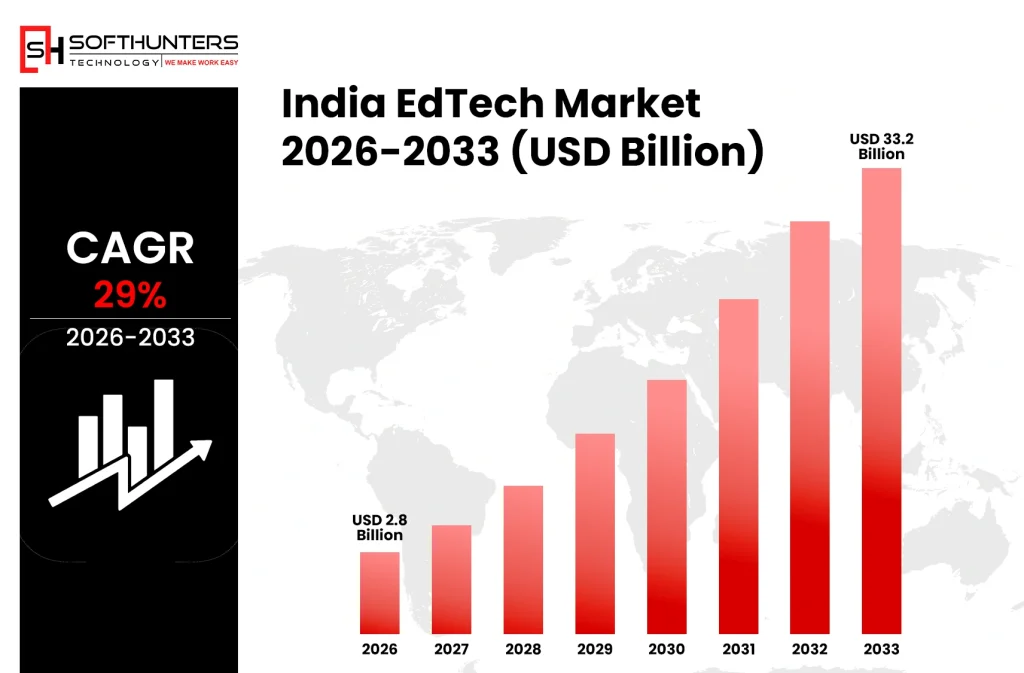
India’s edtech market is already worth around USD 2.8 billion and is projected to grow to roughly USD 33.2 billion by 2033, with a compound annual growth rate of nearly 29%.
The COVID‑19 pandemic has catalysed the transition to online learning in ways that no amount of government support or policy change could, and many Indian families are now vocal supporters of mobile‑first education.
Popular use cases include:
- School and coaching apps (CBSE, ICSE, state boards, JEE, NEET, CA, etc.)
- Vocational and skill‑based courses (coding, design, finance, digital marketing)
- Language learning and exam prep (English, UPSC, SSC, banking exams)
For Indian EdTech founders, this means:
- Large‑scale user base potential
- Need for language support (Hindi, regional languages)
- Preference for low‑data‑consumption and offline‑friendly experiences
This is why businesses today are actively partnering with a reliable e-learning application development company to build scalable and user-friendly platforms.
Key Types of Education Apps
Before diving into features and cost, first decide what type of education app you want:
| App Type | What it does | Indian examples & relevance |
| School/college LMS | Assignments, attendance, notices, report cards | School‑based apps, university portals |
| Coaching and test‑prep apps | Video lectures, quizzes, mock tests, and doubt‑clearing | JEE/NEET, UPSC, banking prep |
| Language and upskilling apps | Short courses, flashcards, practice exercises | Coding, English, spoken‑skills apps |
| Gamified learning apps | Interactive games, badges, rewards, leaderboards | Kids’ apps, quiz‑based learning |
Understanding your target user (school student, working professional, parent, teacher) will shape your feature list and budget.
Many startups also explore education clone app development to copy proven models to enter into the market quickly.
Core Features Every Education App Should Have
Concentrate on simplicity, stability, and low costs for Indian audiences. Whether you’re planning a custom platform or leveraging mobile app development services, these features form the foundation of any successful education app.
1. User Registration & Profiles
This feature allows:
- Email/mobile signup
- Access based on role (student, teacher, parent, admin)
- Set up of profile (board, class, subject, medium of instruction)
Indian parents usually need transparency to track their child’s progress, so clear role separation is an essential part.
2. Course & Content Management
- Course catalog with filters (board, class, subject, language)
- Systematic modules and lesson plans
- Video and audio lessons (with playback controls)
- PDFs, notes, and downloadable study material
Most of the Indian students study in low ‑ bandwidth environments, therefore, include:
- Low‑quality video options
- Downloadable notes and assignments
3. Interactive Learning Tools
To keep students engaged, the app should have:
- Multiple‑choice quizzes
- Short‑answer tests with auto‑grading
- Flashcards and revision tools
- Practice papers and previous‑year questions
Mock tests with a timer and analytics are expected for coaching apps.
4. Progress Tracking & Reports
Indian parents and teachers want tangible results. Include:
- Progress bars for each subject/course
- Weekly/monthly performance reports
- Improvement- Visual charts (line graphs, bar, or plot)
For school‑based apps, integrate with:
- Attendance
- Internal marks
- Final report cards (PDF download)
5. Communication & Doubt‑Clearing
To build trust and retention:
- In‑app chatting for students and teachers
- Q&A forums or doubt‑clearing sections
- Inter-com or push alerts (for exam dates, class changes, etc.)
In India, many prefer WhatsApp‑style chats directly inside the app.
6. Offline Access
Mobile data is also expensive for many Indian students. Plan for:
- Downloadable videos and notes
- Offline practice tests
- Sync‑on‑next‑connection
This immediately helps with user retention and app utility.
7. Personalization & AI‑Driven Features (Advanced)
If your budget is in a higher price segment, keep in mind:
- Learning path adaptive (easy, medium, hard)
- AI‑based recommendations based on performance
- Smart reminders and revision schedules
Such trends are getting support among high-end Indian EdTech apps.
8. Payment & Monetization
Most Indian education apps use:
- One‑time course purchase
- Monthly/annual subscriptions
- Freemium model (basic free + premium features)
For India, integrate local payment gateways like:
- Razorpay
- Paytm
- PhonePe (via SDK)
- UPI support
Show clear pricing in INR and offer student discounts or group buys for coaching institutes.
Step‑by‑Step Education App Development Process
The process of building the best education app development in India goes beyond that of development. The main caveat is careful planning around scale, region diversity, and low-bandwidth environments. So, here is what the sequence generally looks like:
Step 1 – Ideation & Market Research
Begin with a clear definition of who you are building for. All you need to do is find out what requirements a student in a big metro city preparing for CBSE exams has, compared to one from a tier 3 town.
Pay close attention to how existing apps are succeeding-and where they lose out. The real opportunity often exists in the gaps, much like regional language learning or niche exam prep.
For India, affordability and availability in different languages with utility on low data (GB) are not just add-ons; they are must-haves.
Step 2 – Feature Planning & Scope Definition
Focus on what matters in the beginning, not trying to build everything at once.
Log in to the course, access videos of lessons, quizzes, etc., are core functionalities. You can always add advanced elements like gamification or AI-based recommendations later.
This is why the simplest approach is to ship an MVP and iterate again based on actual usage. This directly controls costs as well as development timelines.
Step 3 – Technology Stack Selection
The technology will influence performance, scalability, and cost of the system you go for.
Cross-platform framework — Since most of the Indian education apps are built targeting Android and iOS users, efficient cross-platform frameworks for mobile app development will work in this scenario; both Flutter and React Native could be taken into account.
Step 4- UI/UX Design (Mobile-First Approach)
The design decisions must mirror how Indian users use apps.
Easy navigation, large, readable fonts, and ample visual cues make a big difference, especially for younger students or those adapting to digital methods for the first time. Regional languages and dark mode support can make a huge difference in usability.
Even a detail, such as merging symbols with text labels, will help people to engage better and find their way through the interface.
Step 5- Backend Development
However, the essence happens around here.
This means user management, subscriptions, payments, and a content delivery system need to run smoothly in the background. While implementing this, the system needs to be designed considering local requirements like INR transactions, GST aspects, and regional time formats.
Step 6- App Development & Integrations
After the infrastructure is in place, applications actually come together.
This usually consists of an app that is meant for students, a teacher or admin dashboard, and a centralized panel to manage the content and users. At this stage, use cases like video hosting, document storage, and payment gateway integrations are also implemented.
Step 7 – Testing & Quality Assurance
It’s very important to test in the way and around you use most commonly.
Which means testing for performance on budget Android devices, via slower internet connections, and different language settings. Problems crop up even with areas such as offline access, payment flows, or video playback—hence they require more polishing.
Step 8 – Launch & User Acquisition
Once deployed, the next step is getting a good audience.
Publishing on app stores is only the start of your journey. Building Initial traction by targeted ads, tie-ups with coaching institutes, and trial offers can all help.
Feedback is the most crucial thing at this point in time. The next improvements should directly rely on research insights obtained from early users.
What is the Cost of Education App Development in India
The cost of education app development in India depends on the complexity of the topic, platform, and features. Here is a realistic range for Indian developers and agencies (in INR and USD):
1. Based on App Complexity
| Complexity Level | Approx. Cost (INR) | Approx. Cost (USD) | What it includes |
| Basic education app | ₹1.5–3 lakh | ~$2,000–$4,000 | Simple course list, basic videos, quizzes, zero advanced analytics |
| Medium complexity app | ₹3–7 lakh | ~$4,000–$9,000 | Different roles, better UI, mock tests, basic analytics, integration of payment |
| Advanced app | ₹7–15 lakh+ | ~$9,000–$20,000+ | AI-based paths, gamification, offline sync, admin panel, better analytics |
2. Breakdown by Stage (INR)
Typical stage‑wise spend in India:
- Conceptualization & planning: ₹10,000–₹30,000
- UI/UX design: ₹30,000–₹50,000
- App development: ₹1,00,000–₹3,00,000
- Content creation: ₹20,000–₹1,00,000 (videos, notes, questions)
- Testing & QA: ₹20,000–₹50,000
- Deployment & launch: ₹10,000–₹20,000
- Ongoing maintenance (yearly): Additional 15–25% of initial cost
3. Factors that Increase Cost
- Multi‑platform (Android + iOS + web)
- Advanced AI/analytics
- Offline sync and heavy media storage
- Complex admin dashboards and multi‑role workflows
For founders, it’s often cheaper to:
- Start with Android‑only
- Use a cross‑platform framework
- Outsource to a reputed Indian EdTech development agency
4. Hourly Rate Context
In India, typical hourly rates for EdTech developers range from ₹1,500–₹4,000 (approx. $20–$50), as per the experience and location.
The cost may also change depending on whether you pick custom development or education clone app development for faster deployment.
Which Team Should You Form to Develop an Education App?
To build a polished, scalable, and student‑friendly education app in India, you don’t need an army, but you do need the right mix of people.
- Product Manager / Project Owner
- UI/UX Designer
- Mobile App Developers
- Backend & DevOps Engineers
- Full‑Stack Developer (optional but helpful)
- QA / Testing Engineer
- Content & Instructional Design Team
- Growth & Marketing Team
Having the right e-learning application development company makes sure that your team structure and execution is all ready to produce effective results.
Final Thoughts
The best education app development for the Indian market is no longer a luxury; it’s a strategic necessity. With the right mix of features, an efficient development process, and a realistic budget aligned to Indian developer rates, you can launch an app that students, teachers, and parents actually use every day.
FAQs
What features should be in an education app to serve the Indian student fraternity?
Begin with straightforward student, parent, and teacher logins as well as seamless board and class navigation. With video lessons, note downloads, quizzes, progress tracking, and offline availability. A Hindi or regional language could help as it will keep the app usable and light in low‑end phones and slow internet.
How much time does it take to create an education application?
3-5 months is the rough time most Indian startups take to get a basic app live. For features like tests and payments, it generally goes with a timeline for around 5–8 months, but building a full‑fledged platform can extend up to 12+ months, depending on the team size and pace you work with.
What is the cost of developing an education app in India?
In India, an average education app costs anywhere between ₹1.5–3 lakh. Well, a medium-sized app with more features is about ₹3–7 Lakh, and a high-end app with AI-type tools and dashboards can go up to ₹7–15Lakh or even more based on what you build & who builds it.
Which Technology Stack is Best For An Education App?
The majority of education apps use Flutter or React Native, so one team can do both Android and iOS. They combine this with backends such as Node.js, Django, or Laravel and databases like PostgreSQL or MySQL. Videos and notes are typically hosted on cloud servers such as AWS or Google Cloud.
As a startup, what roles would I require to build an education app?
A small startup, as you can start off with a founder, 1–2 developers, one designer, and one tester. You will also require a content team, including teachers or tutors, and an individual to edit free-style, short mobile-first videos. You do not need a big team on day one, growing the team as students start to use the app, and you know what is really important.