
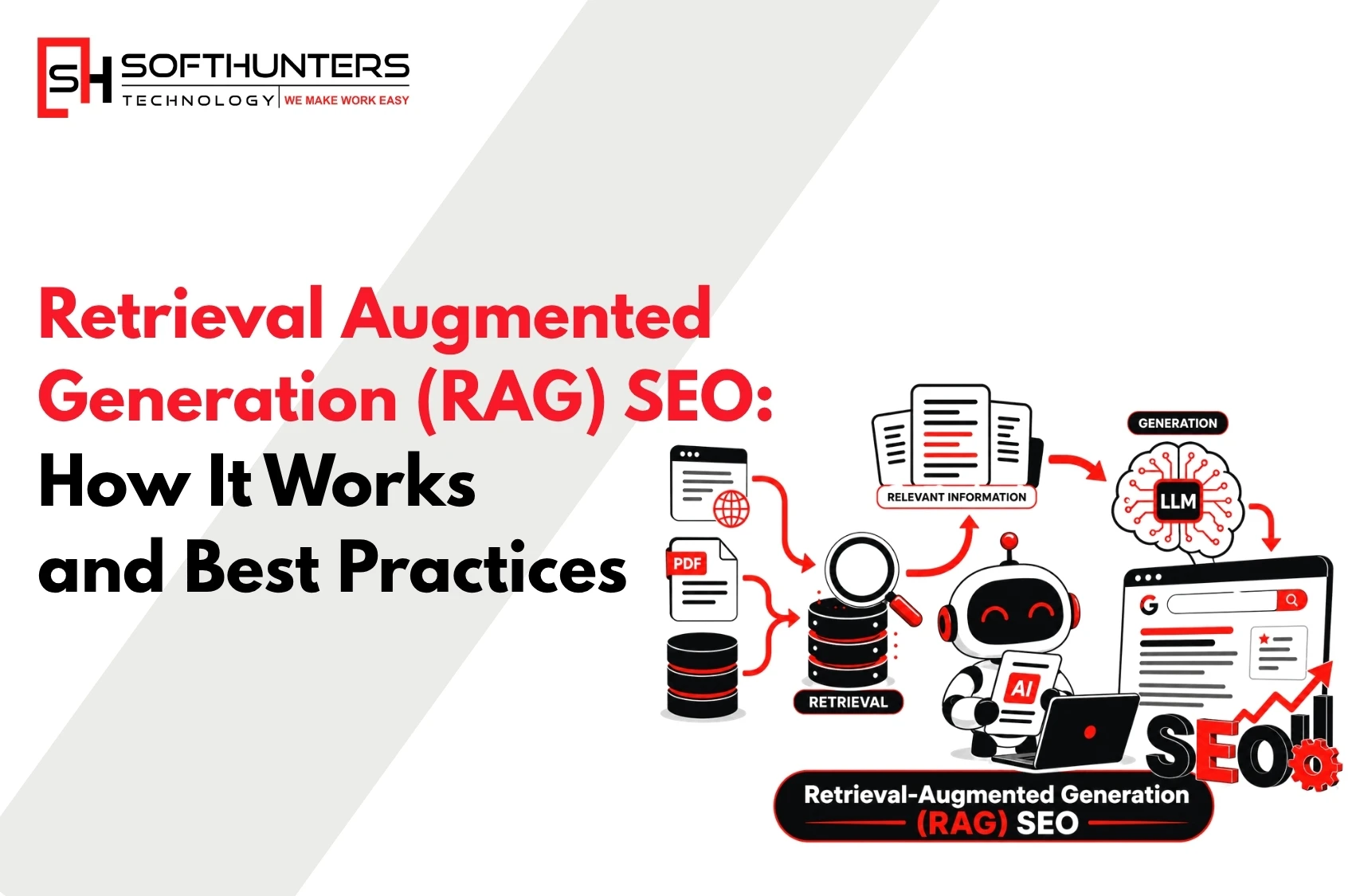
Retrieval-Augmented Generation (RAG) SEO is the practice of optimizing your website’s content so AI search systems can find, retrieve, and cite it when generating answers for users. It is not a replacement for traditional SEO; it is what happens when search engines become capable of reading your content, understanding it, and quoting it directly in AI-generated responses instead of just ranking your page.
If AI systems are not retrieving your content, you are invisible to a growing share of search traffic. This guide explains why that matters, how the technology works, and exactly what to do about it.
What Is RAG SEO?
RAG stands for Retrieval-Augmented Generation. The name is technical, but the idea is not.
Standard AI language models — the kind that power early versions of chatbots — rely on what they learned during training. That knowledge has a cutoff date. It goes stale. And it cannot verify facts against the real world.
RAG fixes this. Instead of answering purely from memory, a RAG-powered AI searches external sources first, retrieves the most relevant content, and then generates a response grounded in that retrieved material. Modern AI search systems often combine language models with retrieval techniques, although the implementation differs by platform.
| Parameter | Standard LLM | LLM with RAG |
| Knowledge Source | Training data only | Training data + real-time retrieval |
| Information Currency | Limited to cutoff date | Current, up-to-date |
| Hallucination Risk | Higher | Lower — grounded in retrieved content |
| Source Attribution | Cannot cite | Can cite specific sources |
RAG SEO, then, is optimizing your content so it gets selected during that retrieval step — not just ranked in the traditional blue-link results.
How Does RAG SEO Work? The 3-Step Process
When someone asks ChatGPT or Google AI Overviews a question, three things happen in sequence:
Step 1 — Query Understanding:
The AI analyses what you are actually asking — not just the words, but the intent behind them. Is this a simple factual question? A complex multi-part research query? A local search? The system decides based on this analysis how much external retrieval is needed.
Step 2 — Retrieval:
This is where your content either gets selected or doesn’t. The system searches indexed web pages, pulls the most semantically relevant passages — not full pages, but specific chunks — and evaluates them for accuracy, freshness, and relevance. Content that is well-structured and clearly written gets retrieved. Vague, thin, or outdated content gets passed over.
Step 3 — Generation:
The AI combines retrieved passages to construct a response. It may cite the source directly. Or it may synthesize across several sources without explicit attribution. Either way, your content influenced the answer — but only if it made it through Step 2.
When RAG is NOT triggered?
Simple, stable factual queries — “what is machine learning?” or “capital of France?” — don’t trigger retrieval. The AI already knows the answer. For these queries, RAG SEO is irrelevant. Focus RAG SEO effort on time-sensitive, complex, or specific queries where the AI needs to look things up.
Here is an example:
How it looks in practice:
Query: “Best CRM software for startups”
Step 1 — Query Understanding: The AI identifies this as a commercial, time-sensitive query requiring current product information. RAG is triggered.
Step 2 — Retrieval: The system searches indexed pages and pulls specific passages — not full articles — from pages covering CRM comparisons for startups. A passage from a 2026 updated comparison page gets selected because it is structured clearly, covers multiple options, and includes recent pricing.
Step 3 — Generation: The AI assembles an answer referencing 3–4 CRM tools, with citations linking back to the pages whose passages were retrieved.
What this means for the page that got cited: It was not necessarily ranked number one. It had a self-contained, clearly structured passage on exactly this topic, updated recently, on a site with topical authority in software reviews.
RAG SEO vs GEO vs AEO — The Difference Finally Explained
Three terms. Constant confusion. Here is the clearest explanation available:
GEO (Generative Engine Optimisation) — optimizing content to appear in AI-generated responses across platforms like ChatGPT, Perplexity, and Google AI Overviews.
AEO (Answer Engine Optimisation) — optimizing to provide direct, extractable answers to specific questions. The focus is on being the source that answers a query precisely.
RAG SEO — optimizing content specifically to be retrieved during the retrieval step of a RAG system. It is the technical layer that underpins both GEO and AEO.
But here is what matters most practically: Google Search Central’s official 2026 guidance states that optimizing for AI features is simply a continuation of standard Search Engine Optimisation. From Google’s perspective, AEO and GEO are industry terms, not internal categories. Their core ranking systems determine what gets retrieved in AI features — the same systems that determine organic rankings. This is not a reason to ignore GEO or AEO thinking. It is a reason to stop treating them as entirely separate disciplines requiring completely different strategies.
Why This Changes Everything About Traditional SEO
Here is the number that reframes the whole conversation.
Analysis from multiple SEO researchers in early 2026 — including studies by Dataslayer and independent practitioner audits — suggests that between 17% and 54% of AI Overview citations come from pages outside the top 10 organic results. This range varies significantly by query type, niche, and geography, and has not been confirmed by Google officially. The consistent finding across studies, however, is the same: ranking position alone does not determine AI citation.
A page ranked position 8 with authoritative, well-structured content on a specific subtopic can be cited in an AI Overview while the position-1 page is ignored entirely. This is the shift from “ranking” to “being referenced.” And it requires a different kind of content thinking.
Traditional SEO optimized for click-through rates and keyword positions. RAG SEO optimizes for trustworthiness, retrievability, and the structural clarity that allows an AI system to extract and use your content with confidence. Both matter. But only one of them works in AI search.
What RAG Systems Look For in Your Content
Not all content gets retrieved. RAG systems apply quality filters before selecting passages. Here is what those filters evaluate:
Accuracy — Content that is factually wrong, outdated, or internally inconsistent gets filtered out. AI systems cross-reference retrieved content across sources before using it.
Topical authority — Pages embedded in a broader content ecosystem covering a subject in depth are preferred over isolated pages targeting individual keywords.
Freshness — Recent statistics, current examples, and updated information signal to retrieval systems that the content reflects the present state of a topic, not 2021.
Semantic clarity — Content that uses related concepts, entities, and natural language around a topic — rather.
Entity recognition — RAG systems rely on named entities—people, organizations, and concepts—rather than vague descriptions. Naming specific, verifiable entities strengthens your content’s semantic clarity, boosting AI retrieval accuracy and trustworthiness.
Technical accessibility — If Googlebot or AI crawlers cannot access your page — blocked by robots.txt, rendered only by JavaScript without proper handling, or not indexed — it cannot be retrieved. Crawlability is table stakes.
RAG SEO Best Practices
Write in self-contained passages. RAG systems retrieve chunks, not full pages. Each paragraph should stand alone as a meaningful unit — 50 to 150 words, one clear central idea. If a reader lifted just that paragraph, they should still understand the point.
Build topical authority through content clusters. One page on a topic carries far less retrieval weight than ten interconnected, in-depth pages covering every angle. Build pillar pages with supporting content around every topic you want to be cited for.
Structure content for AI extraction. Headers that describe what each section covers. FAQ sections. Clear definitions. Tables for comparisons. These formats signal extractable information to retrieval systems.
Ensure your content is indexed and snippet-eligible. Check in Search Console that key pages are indexed, not blocked, and eligible to show snippets. Pages excluded from snippets cannot be cited by AI systems.
Update your content regularly. A blog last updated in 2023 is a liability in a RAG environment. Quarterly content reviews — updating statistics, replacing outdated examples — keep your content competitive for retrieval.
Create original research. AI systems actively look for non-commodity content. A survey, original analysis, or proprietary dataset gives retrieval systems something they cannot find anywhere else.
What Google Says You Do NOT Need to Do (Official Myth-Busting)
Google Search Central published its official AI optimization guide— and it directly debunks several practices being actively sold in the SEO market right now.
LLMS.txt files are not needed. Google explicitly states it does not use them. Creating one won’t help or hurt your visibility in Google Search.
You do not need to manually “chunk” your content. Google’s systems are capable of identifying relevant sections within a page without you breaking everything into tiny pieces. Write for human readability. The AI will handle the chunking.
Do not rewrite content specifically for AI systems. AI systems understand synonyms, context, and intent. Writing unnaturally to include every long-tail variation of a query is unnecessary and creates content that reads worse for humans.
Inauthentic mention-building does not work. Paying for brand mentions to appear cited in AI responses is not a valid strategy. Google’s quality systems identify and discount them — the same way they treat link spam.
Structured data is helpful but not required. Adding schema markup can improve rich results in traditional search. But it is not a prerequisite for appearing in AI Overviews. Continue using it as part of your overall SEO — not as a specific AI citation hack.
Source: Google Search Central, AI Optimization Guide, last updated July 10, 2026.
Platform-Specific RAG Optimization
The major AI search platforms use RAG differently. Here is what matters for each:
Google AI Overviews — Retrieval is based directly on Google’s core search index. If you rank in organic search, you are eligible to be cited. If you are excluded from snippets, you are not. Standard SEO done well — plus snippet eligibility — is the optimization path here.
Perplexity — Performs real-time web searches and attributes sources explicitly. Fresh, clearly sourced content with direct answers performs well. Appearing in top search results for the specific query is the main citation driver.
ChatGPT with Browse — ChatGPT with Browse — OpenAI has not published official retrieval preference rules. Based on practitioner testing and community observations in 2026, ChatGPT appears to reference established, authoritative domains more consistently than newer or lower-authority sites. Brand depth and topical coverage seem to carry more weight than individual page optimization — but treat this as an informed observation, not a confirmed ranking signal.
Across all platforms — Accurate content, clear structure, technical accessibility, topical authority, and regular updates. These are universal.
How to Measure RAG SEO Performance
Google Search Console — Generative AI Performance Report. Filter by “AI features” as the search type. This shows impressions and clicks coming from AI Overviews specifically. Use this as your primary benchmark for Google AI visibility.
Peec AI — Purpose-built for tracking brand citations across LLM platforms including ChatGPT, Gemini, and Perplexity. Gives you a quantified view of where you are and are not being referenced in AI-generated responses.
Brand24 — Combines traditional web mention tracking with AI-source monitoring. Useful for connecting brand mention growth across the web to citation improvements in AI systems.
Otterly.AI — Tracks brand visibility specifically across AI chat interfaces. Useful for benchmarking against competitors in AI citation share.
Manual monthly spot-check — Query your 10 most important target keywords directly in ChatGPT, Perplexity, and Gemini. Screenshot the responses. Track month over month whether you are being cited, partially referenced, or absent. Low-tech. Still essential.
RAG SEO Audit Checklist
Tier 1 — Quick Wins (30 minutes per page):
- Is the page indexed and snippet-eligible in Search Console?
- Does each section have a clear, descriptive header?
- Is there at least one FAQ section with direct Q&A answers?
- Is the key statistic or claim in the content from the last 12 months?
- Does each main paragraph stand alone as a self-contained idea?
Tier 2 — Deep Audit (strategic):
- Does this page sit within a content cluster covering the topic comprehensively?
- Are key entities (people, organizations, concepts) named and explained?
- Is there original data, research, or analysis that cannot be found elsewhere?
- Is the page crawlable by AI systems — no JavaScript rendering blocks, no robots.txt exclusions?
- Has the page been updated in the last 6 months with fresh content?

Work With Softhunters — AI SEO Services That Keep Up With
RAG SEO is not a one-time fix. It is a continuous practice of keeping content fresh, structuring it for AI retrieval, building topical authority, and monitoring citation performance across platforms that are changing every quarter.
Softhunters is a full-service SEO company with 17+ years of experience, now offering dedicated AI SEO services that cover the full RAG SEO stack — technical accessibility audits, content cluster strategy, passage optimization, AI citation monitoring, and performance reporting.
If you want your content to be cited — not just ranked — the conversation starts here.
FAQs
What is the difference between RAG SEO and traditional SEO?
Traditional SEO optimizes for ranking positions in blue-link results. RAG SEO optimizes for being retrieved and cited within AI-generated answers. They are not mutually exclusive — Google’s guidance confirms strong traditional SEO is the foundation for AI visibility. But RAG SEO adds structured thinking about passage clarity, freshness, and content depth that ranking optimization alone doesn’t address.
Does RAG SEO mean creating completely new content?
No. In most cases, existing content needs updating, restructuring for clarity, and freshness verification — not replacement. The biggest RAG SEO wins often come from improving existing pages rather than publishing new ones.
Do I need to optimize differently for Google vs Perplexity vs ChatGPT?
Foundations are the same across all platforms: accurate, authoritative, well-structured, crawlable, fresh content. For Google, snippet eligibility is critical. For Perplexity, appearing in organic search for the query matters most. For ChatGPT, brand authority and topical depth carry the most weight.
How do I know if my content is being cited in AI systems?
Use the Generative AI Performance Report in Google Search Console for AI Overviews data. For broader LLM citation tracking, Peec AI, Otterly.AI, and Brand24 provide structured monitoring. Monthly manual spot-checks — querying key topics in ChatGPT, Perplexity, and Gemini — remain essential for qualitative verification.